Apr
26
2013
 ASEAN Universities Consortium on Food and Agro-based Engineering & Technology [AUCFA] is a consortium established on the basis of common needs in Southeast Asia and the surrounding region to anticipate the globalization of higher education in Food and Agro-based Engineering and Technology. The consortium was established on October 28, 2012 in Bogor, so that is also known as the Bogor Declaration. This consortium accommodates the various activities that are beneficial to all members. The activities include information exchange of academic development, student exchange, staff exchange, joint research, student competition, academic standards development, and the publication of international journals. Addition information could be seen in official web site of AUCFA [http://aucfa.ipb.ac.id/].
Jun
18
2012
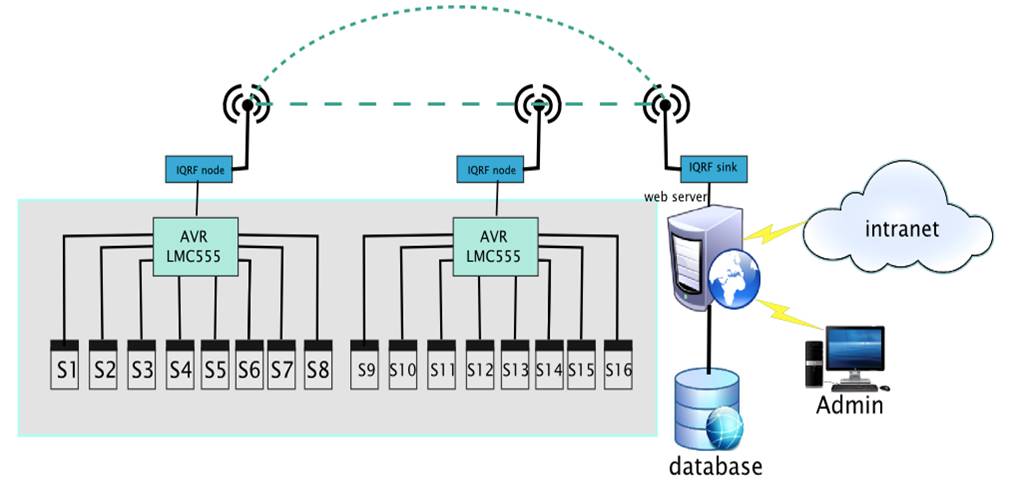
 This study discusses about monitoring system of hydraulic gradient as a parameter which observed to detect the occurrence of landslide on agricultural land-use in the sub district of Kalibawang, Kulon Progo, Yogyakarta, Indonesia. Hydraulic gradient was observed by using low-cost sensor, gypsum block, combined with AVR LMC555, single chip microcontroller, to read soil moisture content. Sensor node positioned as grid distribution to provide equitable and accurate measurement during soil deformation. Wireless sensor networks technology, IQ Radio Frequency( IQRF) and web databases introduced as an alternative technology which can applied to simplify data transmission and information distribution. Hydraulic gradient was observed with the visual observation of soil moisture content as a head approximation in each sensor node.
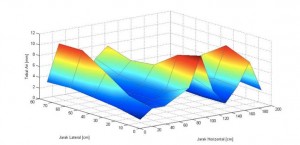
 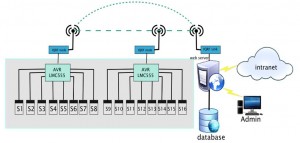 Distribution of soil moisture content in grid system displayed in three dimensional graph to represent soil condition during rainfall induced within a certain time. Verification test of the proposed monitoring system was carried out in the laboratory stage to study about the behavior of the hydraulic gradient and performance of monitoring system. Soil layer was prepared using soil test box (0.74 m x 1.85 m x 0.25 m) filled with the equal soil in research site. Rainfall generator was adapted to supply the intensity of rainfall up to 115.5 mm/day. Further development, low-cost sensor and concept of hydraulic gradient as a hydraulic parameter of landslide occurrence can be use for early warning system with combination with other commercial sensors to enhance the accuracy of the system.
Sep
14
2011
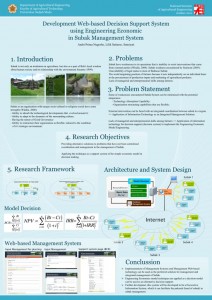
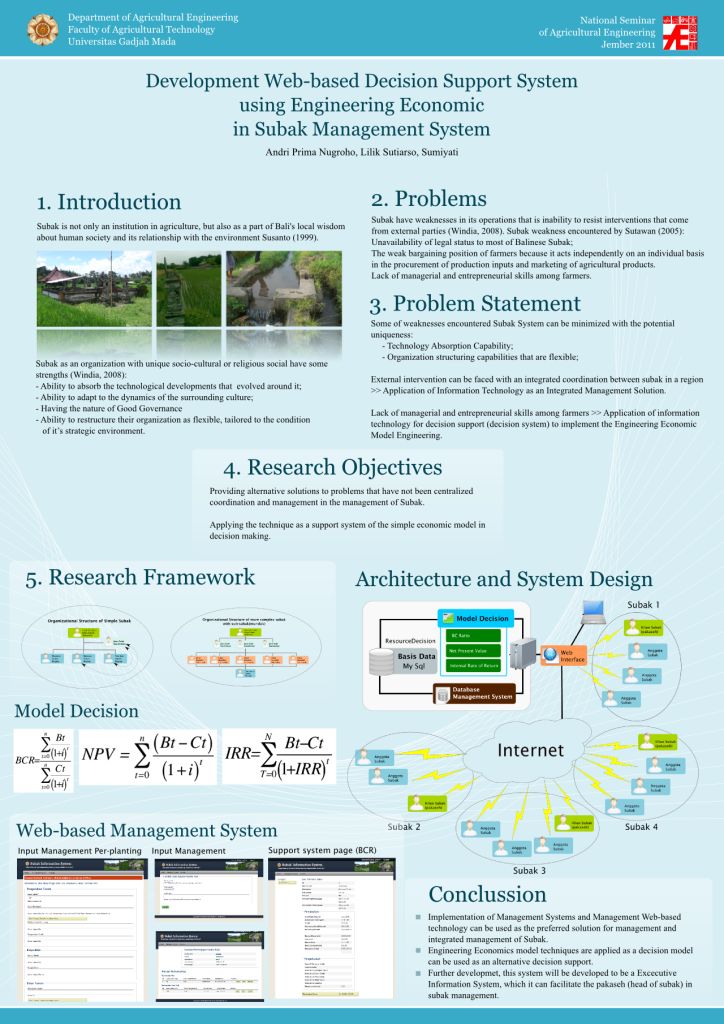
Subak is not only an institution in agriculture, but also as a part of Bali’s local wisdom about human society and its relationship with the environment. Subak as an organization with unique socio-cultural or religious social have some strengths, i.e; (i) ability to absorb the technological developments that evolved around it, (ii) ability to adapt to the dynamics of the surrounding culture, (iii) having the nature of Good Governance, and (iv) ability to restructure their organization as flexible, tailored to the condition of it’s strategic environment.
However, Subak is not free from weaknesses in its operations that is inability to resist interventions that come from external parties. It can be identified are (i) unavailability of legal status to most of Subak, (ii) the weak bargaining position of farmers because it acts independently on an individual basis in the procurement of production inputs and marketing of agricultural products, and (iii) lack of managerial and entrepreneurial skills among farmers.
The research objectives are providing alternative solutions to problems that have not been centralized coordination and management in the management of Subak, and applying the technique as a support system of the simple economic model in decision making.
The research was conducted by Andri Prima Nugroho, Lilik Soetiarso and Sumiyati, and funded by Ministry of Agriculture through KKP3T Program in Year 2010.
Aug
26
2011

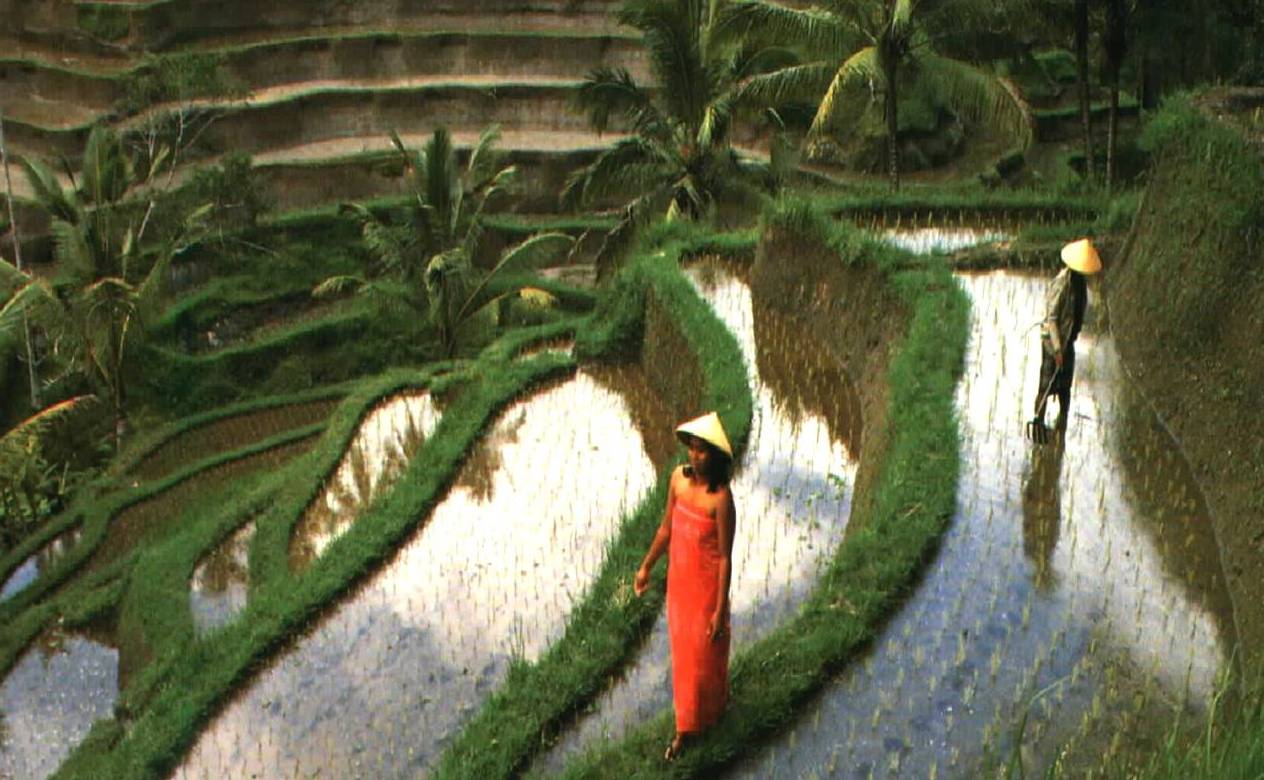
Subak is a customary law community that has the characteristics of socio-religious-agriculture, which represents farmers’ associations that manage an irrigation system in paddy fields. One characteristics of the subak system is of the Tri Hita Karana concept based community management system. Recently, due to development of tourism sector, some problems occur i.e.: (i) decreasing agricultural land area, (ii) declining youth’s interest in farming system caused by the prospect of an employment opportunities to other sectors, (iii) others interest contained to water beyond agricultural sector. The main purpose of study were to identified the strengths, weaknesses, opportunities, and challenges faced by subak and to find some alternative strategies to subak development.
The assessment using the AHP results that subak development as agroecotourism zone is the alternative strategy with higher value compare to either massal tourism zone and agricultural field zone. Through the development of subak as an agroecotourism zone, this alternative can support the sustainability of subak system among Bali tourism development, which is a synergy between tourism and agriculture.
The study was conducted by Sumiyati, Lilik Soetiarso, Wayan Windia and Putu Sudira (published by: Journal Agritech Faculty of Agricultural Technology Universitas Gadjah Mada, Vol.31(2), May 2011).
May
12
2011
Universitas Gadjah Mada and National Agency for Amil Zakat (Baznas) opened the activity of “Zakat Community Development” program in order to develop Srimartani village as an Agropolitan region to support food security program.
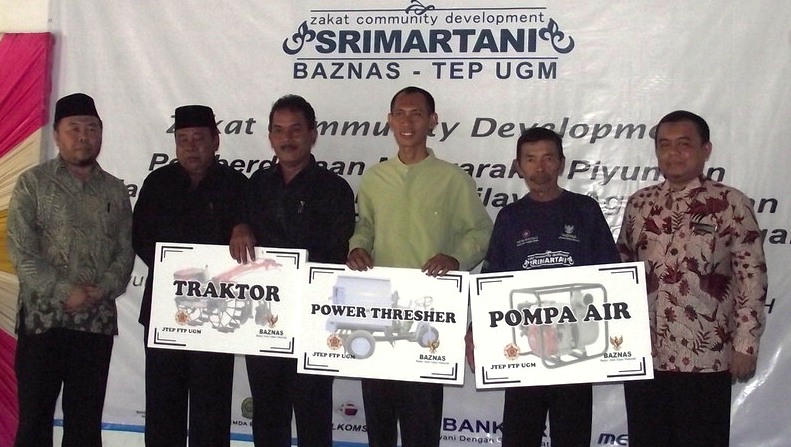
The opening was marked with symbolic handover of aid in the form of agricultural equipment and machinery such as tractors, water pumps and power thresher to the representatives of farmers groups in Srimartani Village, Wednesday (4/5). The activity taking place at the Village Hall was attended by Chairman of Baznas, Prof. Dr. Didin Hafidhuddin, Vice Regent of Bantul Drs. Sumarno and Assistant to Senior Vice Rector for Academic, Research and Community Service of UGM, Prof. Dr. Ir. Zuprizal.
Srimartani is one village in Piyungan Subdistrict, Bantul Regency, bordering to Sleman and Gunungkidul Regencies. Most of villagers in Srimartani have livelihoods on agriculture. Their main problem in the agricultural sector is farming productivity which is not optimal, needing improvement by agricultural intensification approach.Team Leader of Community  Development Program, Dr. Ir. Lilik Soetiarso, M. Eng., said that some programs had been conducted in community empowerment, namely developing local ingredients-based superior food products. “Recently, Bantul has conducted movement to reduce dependence on wheat. Through this program we hope Srimartani Village within 2-3 years will produce local ingredients-based food. The village is famous for vegetable products, bananas, cassava, etc, and has the potential to develop superior products,” said staff of Agricultural Engineering Dept., Faculty of Agricultural Technology UGM. Not only the agricultural programs, UGM Agricultural Engineering Team will also run program for water conservation and land management. This was done because the village’s topography is hilly and often has difficulty in obtaining clean water. “We prepared the technology to prepare clean water and encourage eco-friendly agricultural technology,” he said.
In addition, the team from UGM will empower and increase optimization of livestock waste because some villagers are farmers. “There are 13 livestock’s farmer groups here, so, they will process the waste into biogas. Meanwhile, biogas solid waste is converted into organic fertilizer to support farming,” he said. Prof. Dr. Didin Hafidhuddin said that village development of Srimartani as agropolitan region is one form of zakat distribution program for community empowerment activities. According to Didin, this activity is one of the pilot programs which will be adopted by the Islamic Development Bank (IDB) for poverty alleviation programs in Asia, Africa and the Middle East.
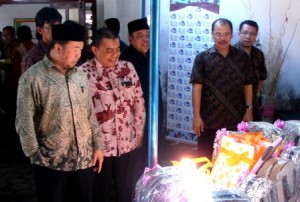 Meanwhile, the Vice Regent of Bantul welcomed the implementation of community empowerment programs in Bantul in order to assist the government to improve the welfare of Bantul community. “The success of this program depends on the awareness and participation of society and those who have supported it,” he ended his speech.
_______________________________
Source: http://www.ugm.ac.id/en/?q=news/ugm-and-baznas-opens-srimartani-village-agropolitan-region
Link:
http://www.radarjogja.co.id/berita/metropolis/16431-desa-srimartani-jadi-kawasan-agropolitan.html
http://www.baznas.or.id/new/detail_berita.php?id=20110503001
http://republika.co.id:8080/koran/0/134409/Baznas_Prakarsai_Zakat_Community_Development_di_Bantul
Mar
20
2011
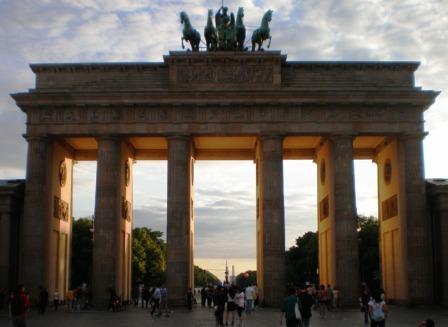
The German Academic Exchange Service (DAAD), the German Rectors´ Conference (HRK), the Gadjah Mada University, the University of Applied Sciences Osnabrück and the Centre for Higher Education Development (CHE), in cooperation with the Alexander von Humboldt Foundation (AvH) were jointly organising part III of the International Deans’ Course (IDC). This intensive training course was part of the DIES programme (Dialogue on Innovative Higher Education Strategies) which has been jointly coordinated by DAAD and HRK since 2001.
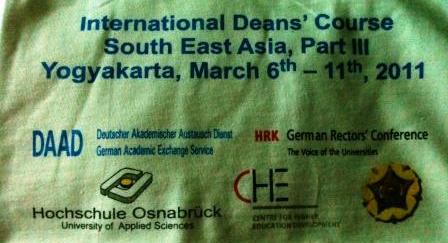
The key objective of the course was to bring together a group of about 30 deans, vice-deans, and heads of departments – many of them alumni of DAAD and Humboldt Foundation – from Universities in South East Asia and to prepare them for the challenges of holding a dean’s position in a changing higher education landscape.
Sep
16
2010
 GEN stands for Gadjah Mada University – Indonesia and Ehime University – Japan Network that is U to U collaboration based on a mutual cooperation, as a forum for academics and institutions to share new knowledge and research results on some particular subject or global issues. This year, the 3rd GEN International Seminar was held on August 2010 in Bali, Indonesia. The event is organized by Gadjah Mada University, Ehime University, RISPESCIA (Indonesian Supply Chain Research and Development) and incorporation with some universities, both from Indonesia as well as Japan. The theme of 3rd GEN International Seminar was “Sustainable Bio-resources for Global Welfare”, it provides a forum for representatives from the public, researchers, scientists, professionals and policy makers to join. Furthermore, related topics in the seminar were (a) Forest Carbon Budgeting for REDD, (b) Zeolite Chemistry and Its Industrial Application, (c) Plant Factory, (d) Biodiversity and Natural History Museum, (e) Functional Food, (f) Molecular Genetics of Tropical Rain Forest, (g) Hydrological Issues under Global Warming, and (h) Supply Chain in Practices. The author has presented his research paper titled “Application of Web-based Monitoring System for Plant Growing by Using Machine Vision” that prepared together with Mr. Atris Suyantohadi, Mr. Dody Kastono and Mr. Andri Prima. Special thanks to Faculty of Agricultural Technology UGM for supporting us to participate in the seminar.
Sep
16
2010
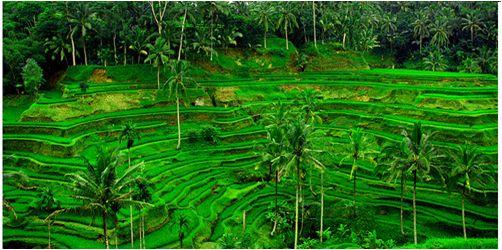
The Subak farmers’ institutional mandates that limited to only the management of irrigation systems for farming system in Bali should be again considered in line with regional development. “Agro” based integrated development became one of the alternative solutions for strengthening the Subak farmers’ institutional autonomy, namely agroecotourism system development. This model is expected to be used as a means and the media in improving the performance and management capacity building for the subak farmers’ institution. Furthermore, the farmer groups as a “subject of development centre” have very important role in the regional development that based on the “agricultural” sector. Objectives of the study are (i) for empowering and strengthening Subak as farmers institutional system that based on “good governance system”, indicated by the principle of need, effectiveness, efficiency, flexibility, benefits, equity and sustainability, (ii) to improve the farmers institutional performance, that indicated by the ability as “income generating unit”, beside as well as “socio-cultural based farmers’ institution, (iii) to provide feedback for policy makers in local government in relation to regional development strategy.
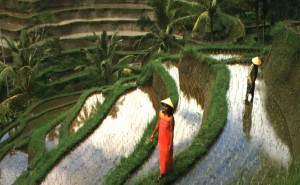 The results of this study are expected to have impacts on (1) Sustainable ecotourism, (ii) welfare of the Subak members, and (iii) Subak sustainability and its autonomy. The study is funded by KKP3T Program – Ministry of Agriculture year 2010.
Sep
15
2010
The German Academic Exchange Service (DAAD), the University of Applied Sciences Osnabrueck (FHOs), the German Rectors’ Conference (HRK), the Centre for Higher Education Development (CHE) in cooperation with the Alexander von Humboldt Foundation (AvH) are jointly organising the International Deans’ Course. This intensive training course is part of the DIES programme (Dialogue on Innovative Higher Education Strategies) which has been jointly coordinated by DAAD and HRK.
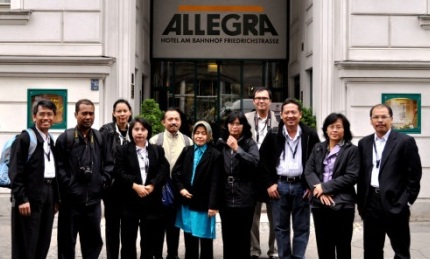
The key objective of the course is to bring together a group of about 30 deans, vice-deans, and heads of departments and to prepare them for the challenges of holding a dean’s position in a changing higher education landscape.

Issues such as faculty management, higher education governance, financial management, change management, quality assurance and leadership will be key parts of this course. A soft skills workshop and an exchange with German university leaders about higher education reforms will be included. Part I of this course was held in Osnabrueck and Berlin on June 2010.
Mar
30
2010
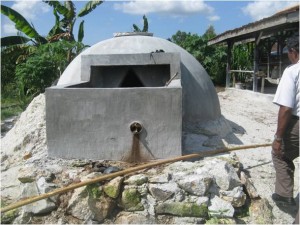
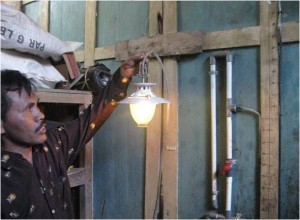
Recently, Indonesia is facing the seriously problems regarding the national agricultural development, likely: low productivity, decreased number of farming labor caused by shifting an agricultural labor to non-agricultural labor, unpredicted climate, limited energy resources in agriculture, etc. We are having some difficulties to introduce high level of agricultural technology due to characteristics of the Indonesian agricultural.
The most important issue in agriculture field, especially in the developing country is energy use and its efficiency. The “energy crisis” triggered considerable debate on the energy needs of agriculture and the efficiency with which it is used. Many now feel that the energy use for agriculture is much too high in the developed countries (European Countries) than in the developing countries, and that farming systems are therefore not sustainable. Some facts showed that the energy ratios of traditional agriculture vary from about 5 to 70 as compared with 0.1 to 5 for agriculture in industrial countries. Traditional agriculture results in food energy outputs which are extremely high in comparison with energy used in their production. Thus when considering the sustainability of farming system from the point of view of energy use, the developing countries farming system are more sustainable than the industrial countries.
Since 30 years ago, when petroleum prices began to increase dramatically, people have become more aware that liquid fossil fuel is a finite resource, and that steps to conserve the supply and improve the efficiency with which it is used are very much in order. This awareness has also led to increased interest in developing alternative sources of energy and increasing the scope of use of known sources. The dominant influence of the urban sector over the rural sector in most countries has caused the use of energy in agriculture to be singled out for special challenge. In many cases this challenge has focused on agricultural mechanization, particularly farm machinery. The relatively small share of overall commercial energy consumed by agriculture, the unquestionable need for progressively increasing agricultural output in nearly all countries of the world, and the understanding that high yield agriculture depends to a large extent on energy intensive inputs such as machinery, fertilizers and pesticides, clearly shows that agriculture deserves to be given the highest priority when allocating available commercial energy supplies in most countries.
Based on those problems, the study was focused on renewable energy. Renewable energy sources can be replenished in short period of time. The five renewable sources used most often include hydropower (water), solar, wind, geothermal and biomass. Furthermore, the matter will concentrate to one of renewable energy sources, i.e. biomass. Biomass is organic material, which has stored sunlight in the form of chemical energy. Biomass fuels include wood, wood waste, straw, manure, sugar cane, and many other byproducts from a variety of agricultural processes. In fact, biomass continues to be a major source of energy in much of the developing countries, like as Indonesia.
Bio-energy uses biomass, plant matter or animal waste to produce electrically, fuels and heat. Examples include ethanol motor fuel, landfill gas and wood burned in fireplaces and stoves. As we know, ethanol is the principle liquid fuel made from renewable resources. Use of biomass as a fuel offers some environmental advantages over fossil fuels like coal and oil, but can also have significant negative impacts on the environment. Other renewable fuels include biodiesel and hydrogen. Renewable fuel production provides jobs in rural areas while reducing dependency on imported petroleum.
Using liquid fuels from renewable biomass can actually decrease the accumulation of greenhouse gases while providing clean, efficient energy for transportation. In the future woody and herbaceous bio-energy crops could provide clean-burning fuels for a renewable fuel economy. Entrepreneurs and investors with vision and the access to appropriate technologies can tap into these abundant renewable, environmental resources. One of the principal benefits of biomass fuels is that it provides a storable transportation fuel while reducing the effects of greenhouse warming.
Indonesia as the developing country has high potential to produce bio-energy by using agricultural product waste, but an appropriate technology and supporting facilities to process it were very limited. In the future, in order to overcome the fossil energy crisis, we have to strongly develop the alternative bio-energy.

 ASEAN Universities Consortium on Food and Agro-based Engineering & Technology [AUCFA] is a consortium established on the basis of common needs in Southeast Asia and the surrounding region to anticipate the globalization of higher education in Food and Agro-based Engineering and Technology. The consortium was established on October 28, 2012 in Bogor, so that is also known as the Bogor Declaration. This consortium accommodates the various activities that are beneficial to all members. The activities include information exchange of academic development, student exchange, staff exchange, joint research, student competition, academic standards development, and the publication of international journals. Addition information could be seen in official web site of AUCFA [http://aucfa.ipb.ac.id/].